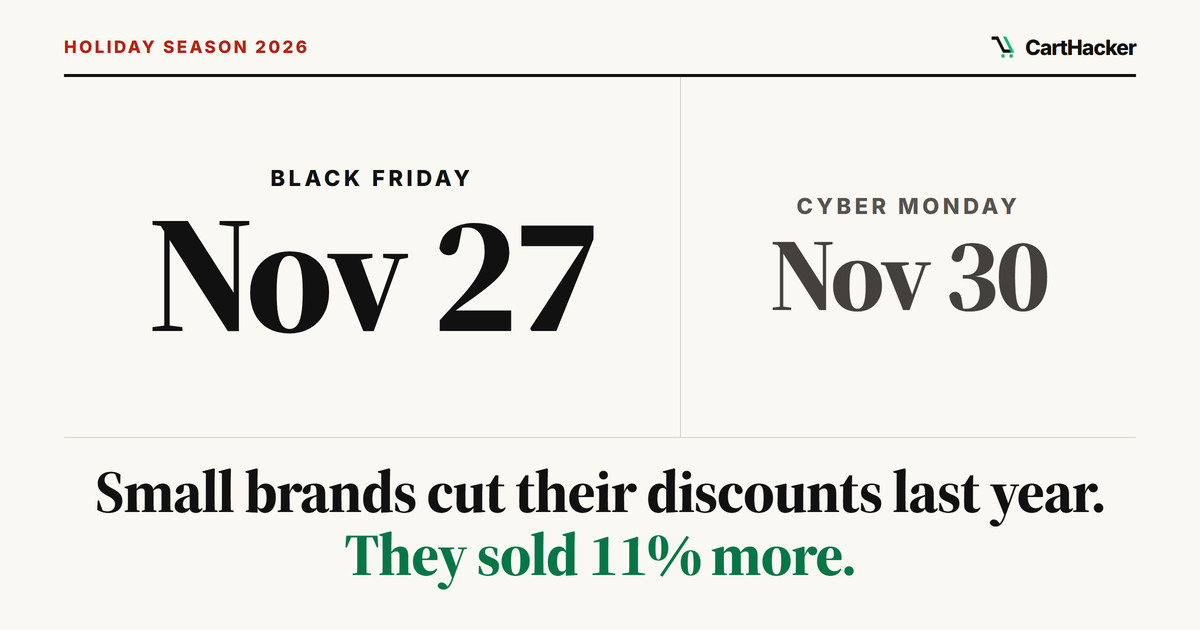
Every Black Friday guide starts with the discount: how big discounts, how early, how many discount codes to set. Klaviyo looked at what its customers actually did last year, and the numbers point the other way. Small and mid-size brands cut their average discount from 29.6% to 26.2% and still sold 11% more on the same sites than the year before.
This year, therefore, I would pay less attention to the percentage itself and focus more on three issues that generate high costs for online stores every November: a welcome code that stacks on top of a sale price, a product page that slows down when the traffic arrives, and a first-time visitor who doesn't trust a store they've never heard of.
If you run a small or mid-size Shopify or WooCommerce store and you're getting ready for Black Friday on November 27 and Cyber Monday on November 30, 2026, here's the plan: the dates that matter, what the forecasts say will sell, an offer that protects your margin, the exact coupon settings on both platforms (tested on a WooCommerce store), the speed and trust checks, and the shipping and fraud dates to put in your calendar.
The 2026 Black Friday countdown starts before November
Thanksgiving falls on November 26, which means Black Friday is on November 27, and Cyber Monday on November 30. However, shoppers aren't waiting until then: 43% of them plan to start their holiday shopping even before November (according to an October NRF survey), and Deloitte predicts that a larger portion of the holiday budget will be spent by the end of October than in any of the last six years. Is your offer ready yet?
| Date (2026) | What happens |
|---|---|
| November 5 | Target's Early Black Friday starts |
| November 8 | The day fraud started rising last year, by Stripe's count |
| November 11 to 30 | TikTok Shop's Black Friday and Cyber Monday campaign |
| November 26 | Thanksgiving, $6.9 billion online in Adobe's forecast |
| November 27 | Black Friday, $12.9 billion |
| November 28 | Small Business Saturday |
| November 30 | Cyber Monday, $15.1 billion, the biggest day |
| December 17 | USPS Ground Advantage, last day to ship for Christmas |
| December 18 | USPS Priority Mail |
| December 19 | USPS Priority Mail Express |
Amazon and Walmart hadn't announced their Black Friday dates when I wrote this on October 24; last year Amazon's Black Friday Week started on November 20.
More money, about the same number of orders
Adobe expects $275.1 billion to be spent online in the US between November 1 and December 31, 6.7% more than last year, with 57.4% of it on phones (63% on Thanksgiving). That sounds like a lot of new orders. It isn't.
According to Bain, inflation accounts for more than half of the growth in sales value during the holiday season. This is supported by Salesforce data from last year's "Cyber Week": average selling prices rose by 6%, while the number of orders increased by 2% globally and by 1% in the United States. This means that retailers will be competing for a volume of orders similar to last year's, but at higher price points. Success will go to those stores that manage to convert a larger percentage of their current visitors into buyers, especially in the case of mobile shopping, where the total cost is clearly visible before the transaction is finalized.
One stream of visitors is growing fast. Adobe expects traffic from AI assistants to retail sites to rise 130% this season, and those visitors have been converting better than average for eleven months straight. If AI assistants can't read your products and policies, my guide to AI shopping agents covers what to switch on.
What will sell in 2026 during Black Friday?
The forecasts agree more than they disagree. Here's Adobe's US online forecast by category:
| Category | 2026 online forecast | Growth |
|---|---|---|
| Electronics | $63.3 billion | +5.9% |
| Apparel | $51.3 billion | +4.7% |
| Furniture | $33.4 billion | +7.3% |
| Grocery | $26.1 billion | +10.3% |
| Toys | $9.6 billion | +9.6% |
| Cosmetics | $9.2 billion | +9.5% |
A greater surprise lies within basic product categories. During "Cyber Week," Adobe anticipates that consumers will stock up heavily on wardrobe essentials - at a rate three times higher than in September - as well as personal care items, and products for children and pets. Last year, on the Shopify platform, the most popular categories included cosmetics, apparel (tops and bottoms), sportswear, and items related to fitness and nutrition. As for toys, sales of games and puzzles grew by 39% during the first four months of 2026 (according to Circana data).
What's cooling: Bain expects furniture, electronics and appliances to be flat once you take out inflation, and on TikTok Shop womenswear sales are down 7.5% this year (FastMoss). The collectible craze is a warning too. Resale prices of Labubu figures collapsed after Pop Mart raised production, so I wouldn't put a season's inventory on a viral item whose resale price has already dropped.
Timing matters by category. Google's own When to Buy guide, built from last year's prices, tells shoppers that fragrance is cheapest within two weeks after Black Friday weekend and handbags in mid-December. If Google is telling your buyers to wait, a fragrance store has a solid reason to keep the offer running into December.
If I were to stock a small shop with this type of assortment in mind, I would focus on consumer goods suitable as gifts, as well as elevated versions of everyday items - such as cosmetic and perfume sets, essential goods and accessories, sportswear, home and kitchenware, pet products, and games - all offered as ready-made gift sets and packages.
A smaller discount, a better offer!
If brands using Klaviyo saw growth while offering smaller discounts, what did they provide instead? Primarily, they offered early access to deals and better incentives for those who had already made a purchase - the number of repeat transactions rose by nearly 14%, compared to a 9% increase among new customers. Two studies explain why such additional perks prove more effective than yet another 10% price reduction.
A gift with purchase is valued by shoppers at about 2.4 times what it costs you, especially when it's cheap to make, fits the main item and comes with a bigger order (according to Hudik, Karlicek and Riha, 2023). And in a retail field test, a bonus pack ("more for the same price") sold more than a price cut worth exactly the same, because people read percentages badly (research: Chen and colleagues, Journal of Marketing, 2012). A T-shirt shop that throws in a second pair of socks might sell more than one that lowers its price by another 3 dollars.
Free shipping is the one extra everybody wants: extra costs are the top reason for abandoning a checkout (40% in Baymard's survey), and Salesforce says free shipping is the top purchase factor at every income level. It can also eat the margin. An older study at one online retailer found free shipping above a threshold brought more orders and bigger baskets and still lost money on the shipping. Set the threshold from your own margin, and show it next to the price and again in the cart, because 32% of sites Baymard checked mention free shipping only in a banner shoppers miss.
One rule is non-negotiable: the "pre-discount" price must be genuine. In the United States, Federal Trade Commission (FTC) guidelines on pricing state that the former price must be the amount at which the item was actually offered for a substantial period of time; meanwhile, for sales within the European Union, it must be the lowest price that was in effect over the preceding 30 days.
Remember to stop the welcome code from stacking on your sale prices
Most stores have a welcome code, 10% off the first order for signing up. Most forget it's still live on Black Friday. I tested what that does on my WooCommerce test store: a T-shirt on sale from $28.00 to $22.00, and WELCOME10, a plain 10% code with no restrictions. A guest added the shirt to the cart and typed the code. It went through:
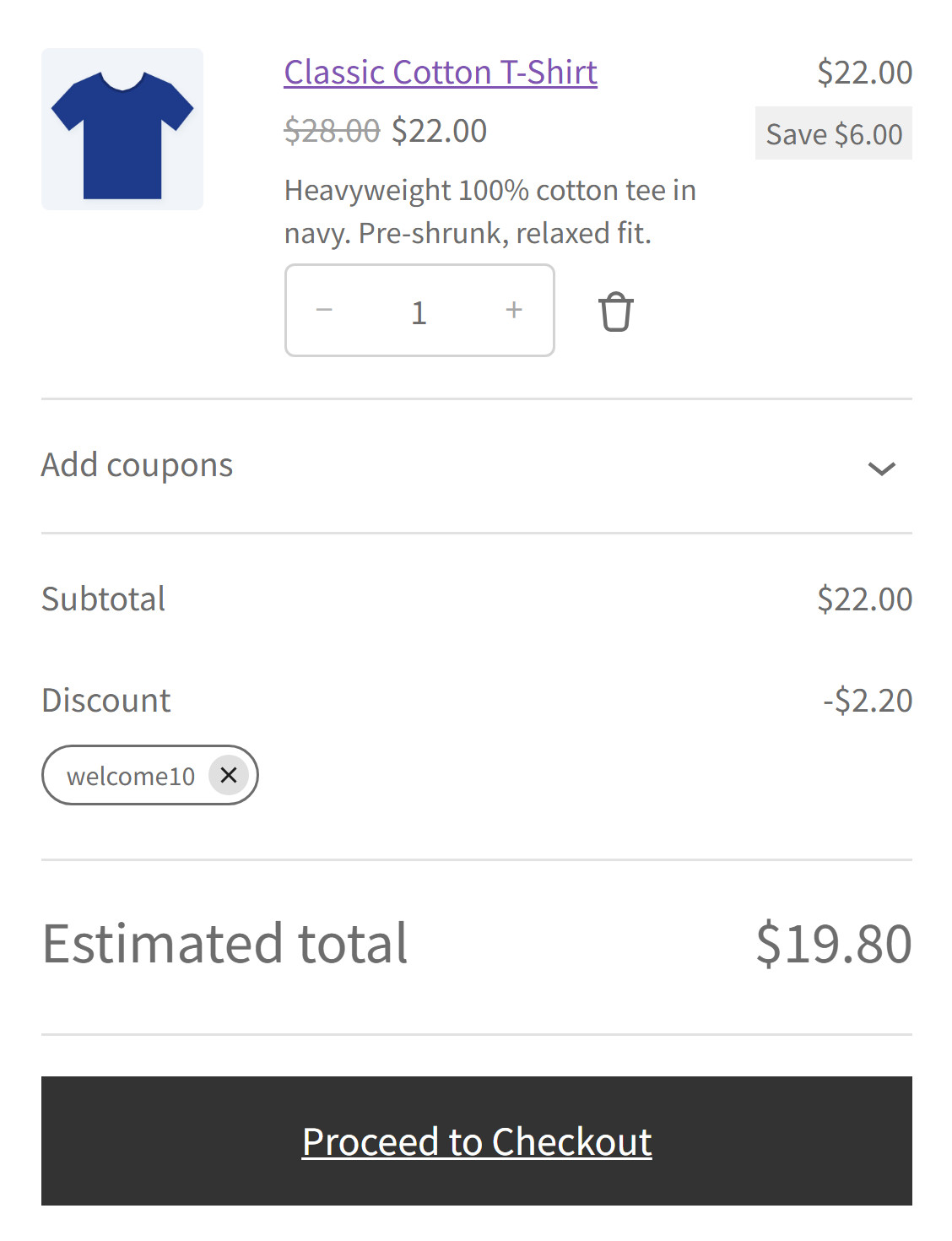
That's 29% off the regular price from a code meant to win a first order, and on a busy weekend it repeats on every order that finds the code. Two checkboxes on the coupon's Usage restriction tab stop it:
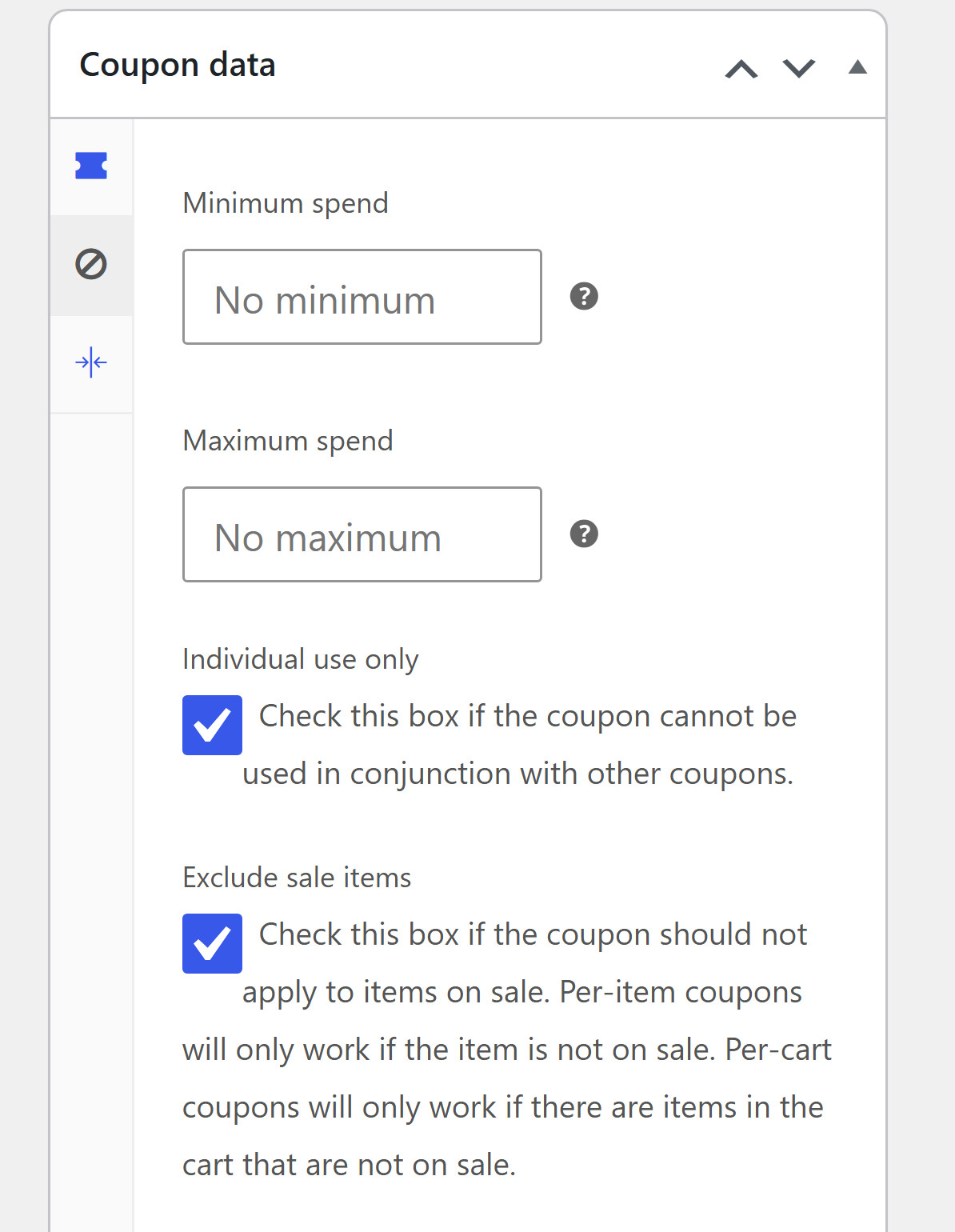
Same guest, same cart, same code, after ticking them:
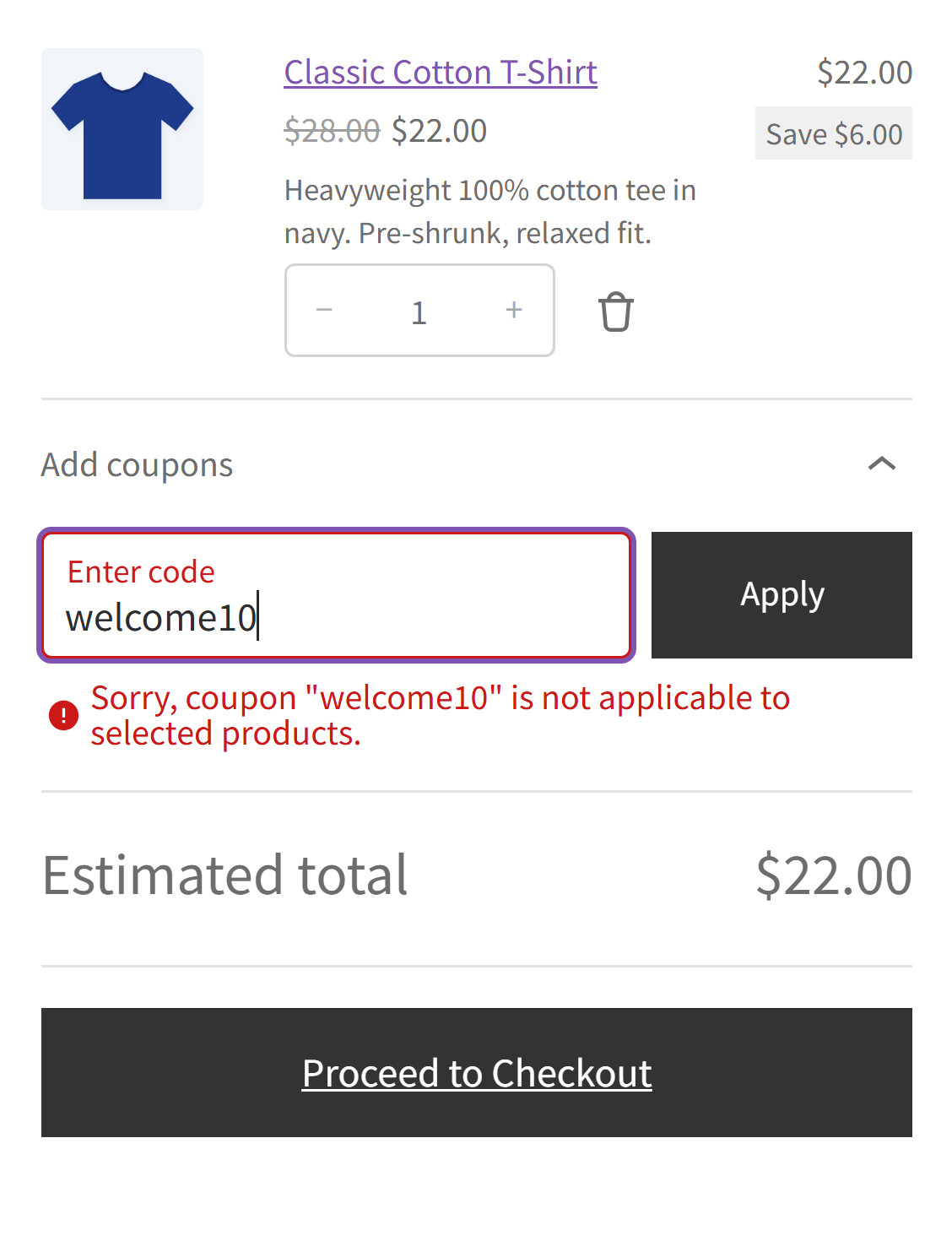
On WooCommerce that's the whole fix: Marketing > Coupons, open the code, Usage restriction, tick Individual use only and Exclude sale items, hit Update. A scheduled sale price counts as a sale item, so your Black Friday prices are covered. One exception from WooCommerce's own documentation: a fixed cart discount still applies when the cart also holds items that aren't on sale.
On Shopify it takes two settings, because Shopify doesn't treat a compare-at price as a discount:
- Combinations. In Discounts, open the welcome code and leave Product discounts and Order discounts unticked under Combinations. Your Black Friday automatic discount can't stack with it then; Shopify applies whichever is better for the cart.
- Collections. A welcome code still applies on top of a compare-at markdown. Create an automated collection with the condition Compare-at price is not set and set the welcome code's Applies to to Specific collections with that collection. (Shopify's caveat: the condition matches a product if any of its variants has an empty compare-at price.)
Then assume, that any publicly available code is likely to leak. An investigation conducted in December 2025 revealed that the browser extension Honey shared private codes with all its users and displayed a list of approximately 146,000 stores without their consent; Google's new "Universal Cart" feature functions similarly, also presenting promotional codes to shoppers. For Black Friday offers, I suggest opting for automatic discounts rather than using manual codes. Codes should instead be reserved for use within closed audience groups - they should be unique, one-time-use, include an expiration date, and be subject to a restriction: one code per customer.
Check the website speed before the traffic does
Speed is where small stores lose sales without seeing it. In Rakuten 24's A/B test, the faster version of one page brought 53% more revenue per visitor, and Deloitte's study for Google found a tenth of a second on mobile was worth 8.4% more retail conversions. When did you last open your best seller on a phone over slow mobile connection??
The default speed varies depending on the platform. The Web Almanac's 2025 numbers give Shopify a 76% pass rate on Google's three speed scores for phones and WooCommerce 35%, and only 39% of WooCommerce stores had a good loading time (LCP).
On Shopify the platform itself takes the load, so a slow store is slow because of its own theme and installed apps. Shopify's own help says uninstalling an app doesn't remove its code from your theme, so check theme.liquid for leftovers of apps you've already removed (requires some investigation and coding experience). On WooCommerce your own server takes the traffic spike, the cart and checkout that cannot answer - are the major reasons that take the money. My WooCommerce server benchmark shows what each fix is worth there.
Whatever you change, finish by mid-November and then freeze the settings. A new app installed on Black Friday morning is the most expensive test you'll run all year.
Test your best-selling product page before November
Paste a product page address and see its three Core Web Vitals scores and the total delay. A free account names the 5 apps that cost the most time, with the fix for your platform.
Test my storeTrust for shoppers who've never heard of your online shop
Black Friday draws people to small shops who have never shopped there before. Research conducted by Baymard shows that 19% of customers abandon their purchase due to concerns about the security of their payment card, while 13% do so because of the return policy. Before a first-time visitor reaches the stage of entering their card details, they need to know who they are dealing with, what will happen if an item doesn't fit, and be reassured that the payment process is secure.
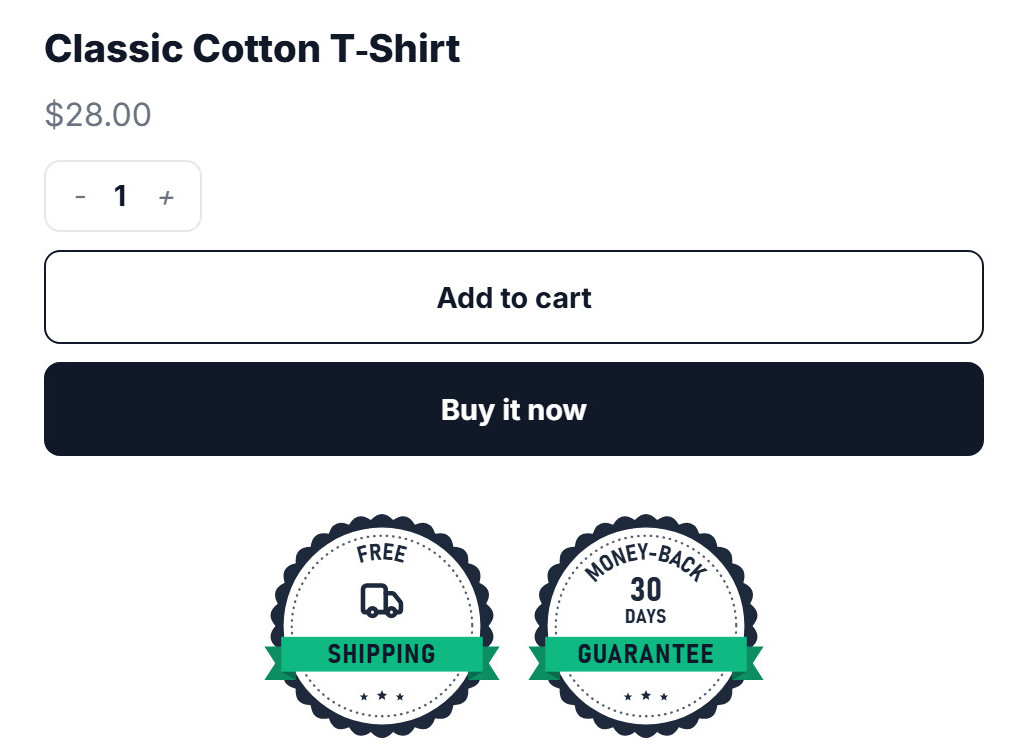
Trust badges help, but spamming them does not. Across 493 retailers and more than 250,000 transactions, Ozpolat and Jank found trust seals work best for small retailers and new shoppers, and that more than two seals can lower the chance of finishing the purchase. Baymard's advice for the checkout is one or two icons near the card/checkout fields. Those studies are about security seals, and I'd apply the same restraint to the promise badges under Add to cart: two that answer your client's two biggest worries: shipping cost and returns.
It is worth mentioning that I created a badge-generation tool for this purpose. Here is its free creator, configured specifically for these two options:
Reviews matter more than either. Northwestern's Spiegel Research Center found a product with five reviews is 270% more likely to be bought than one with none, and that a perfect 5.0 sells worse than a 4.5. Ask last month's buyers for reviews now, so your best sellers have five by November. Don't be fooled: as of October 2024, FTC regulations targeting fake reviews are in effect, and the knowing use of such reviews can lead to financial penalties.
The trust badges guide has the full research and where each badge goes, and the Trust Badges builder makes the two above for free.
Shipping dates, fraud and email delivery
Add information about order deadlines that guarantee on-time delivery to your online store now. You can find the dates for USPS in the calendar at the top of the page. For FedEx Ground, the deadlines are slightly later for shorter-distance shipments, while UPS has not yet published its schedules. I recommend displaying these final order dates on your product pages and in the shopping cart: ideally starting as early as the beginning of December. Also, remember to account for "peak surcharges" applied by carriers when calculating the costs for free shipping; for instance, UPS adds $0.75 to every shipment destined for an individual consumer (a fee in effect since November 22).
As traffic to your store increases, so does the risk of fraud. According to data from Stripe, the number of fraud attempts during last year's Black Friday weekend was approximately 1.7 times higher than usual, with an uptick noticeable as early as November 8. Stripe also warns that overly strict security policies can lead to the rejection of orders from legitimate customers, who often do not attempt to purchase again. If you anticipate a significantly higher volume of sales than usual, notify your payment processor in advance - for example, Shopify Payments may hold back some payouts if transaction volume suddenly spikes.
Ensure that your emails actually reach their recipients. Providers such as Gmail, Yahoo, and Outlook now require senders of mass correspondence to implement SPF and DKIM protocols, as well as a DMARC record. As of November 2025, Gmail has begun rejecting messages that do not meet these requirements. Before launching your first Black Friday campaigns, ensure that these settings are correctly configured; you can find detailed information on this in our email marketing automation guide.
| By | Done |
|---|---|
| November 1 | One public offer decided (an automatic discount, plus a gift or bundle); welcome code restricted; private codes single-use with an end date |
| November 8 | Speed fixes finished; fraud rules checked; SPF, DKIM and DMARC checked; payment provider told about the expected volume |
| November 11 | Early access open for subscribers and past buyers |
| November 16 | Change freeze: no new apps or theme edits until December 1 |
| November 26 to 30 | Watch checkout on a phone each morning, answer messages the same day |
| December 10 | Shipping cut-off notice on product pages and in the cart |
Everything you introduce during the final week will be put to the test in the face of the largest crowd of customers your store will see all year - and I would much prefer that any new implementations, plugins, or tests only encounter that crowd in January.
Sources
Klaviyo, Adobe, NRF holiday survey and 33 more36
- Klaviyo: Why big results don't need big discounts (December 2, 2025)
- Adobe: US holiday shopping season to hit $275.1 billion online (September 28, 2026)
- NRF holiday survey (October 20, 2026)
- Deloitte holiday forecast (October 15, 2026)
- Bain: US holiday retail sales to exceed $1 trillion (September 3, 2026)
- Salesforce: Cyber Week 2025 results (December 5, 2025)
- Shopify: BFCM 2025 results (December 2, 2025)
- TikTok Shop: Black Friday and Cyber Monday campaign (October 19, 2026)
- 9to5Toys: Target Early Black Friday (October 21, 2026)
- Circana toy market report (via Spielwarenmesse)
- FastMoss: what to sell on TikTok Shop in Q4 2026 (August 21, 2026)
- Google: When to buy guide (October 15, 2026)
- Hudik, Karlicek and Riha: the value of promotional gifts, Journal of Consumer Marketing (2023)
- Chen, Marmorstein, Tsiros and Rao: bonus packs versus price discounts, Journal of Marketing (2012)
- Lewis, Singh and Fay: free shipping thresholds, Marketing Science (2006)
- Baymard: cart abandonment reasons
- Baymard: free shipping only in banners
- FTC Guides Against Deceptive Pricing, 16 CFR 233
- WooCommerce: coupon management
- Shopify Help: combining discounts
- Shopify Help: automated collection conditions
- PPC Land: Honey and leaked store codes (December 22, 2025)
- web.dev: Rakuten 24 case study
- web.dev: Milliseconds make millions
- HTTP Archive Web Almanac 2025: Ecommerce
- Shopify Help: improving web performance
- Ozpolat and Jank: third-party trust seals, Decision Support Systems (2015)
- Baymard: perceived security during checkout
- Spiegel Research Center: how online reviews influence sales
- FTC: final rule banning fake reviews (August 14, 2024)
- USPS: holiday shipping dates
- Value Added Resource: 2026 holiday shipping deadlines (September 24, 2026)
- UPS: peak demand surcharges (August 26, 2026)
- Stripe: preparing for peak shopping season 2026
- Shopify Help: Shopify Payments reserves
- Gmail sender guidelines

Discussion 0
Ask a question or share what you saw on your own store.
No comments yet.