Average order value, or AOV, is your sales divided by your number of orders, and you raise it with quantity discounts, bundles and a free shipping threshold. Each of the three works. Each can also lose money, and a free shipping threshold set too close to your average order gives away more in shipping than it brings in. This guide shows the math for all three, the setup on Shopify and WooCommerce, and why one store more than doubled its sales while its average order stood still.
I have built and run online stores since 1998, and the examples come from camelway.eu, a store I built and ran, next to published research on how shoppers react to shipping costs.
What is average order value, and how do you calculate it?
Average order value is what a shopper spends on one order, on average. The formula is short. Divide total sales by the number of orders in the same period, so a store that sold $12,000 in 200 orders last month has an AOV of $60. Shopify shows it on the Average order value card in Analytics, and WooCommerce shows it in Analytics, then Orders.
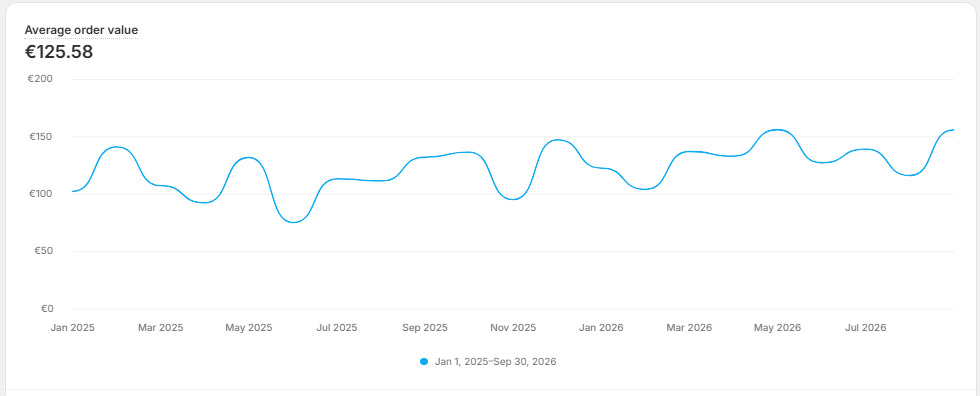
Comparing your number with other stores tells you little, because it depends so much on what you sell. Dynamic Yield, which runs personalization for large retailers, puts the global average at $182, with luxury and jewelry at $421, food and beverage at $81 and beauty at $71. The average on camelway.eu from January 2025 to September 2026 was €125.58. Compare yours with your own past.
Why average order value is not the whole story
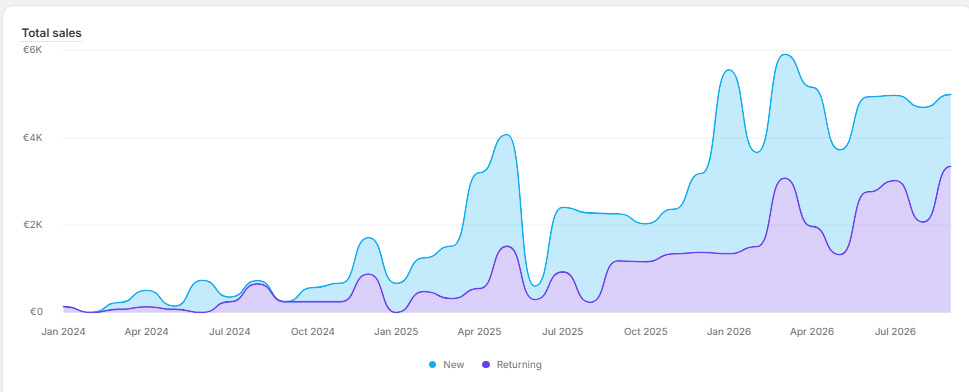
Bigger orders are only one lever. On camelway.eu the average order moved between about €75 and €155 from month to month, around that €125.58, without a lasting jump, while monthly sales grew from about €2,100 on average in 2025 to about €4,800 in the first nine months of 2026.
Returning customers made the difference. Read from Shopify's chart, they brought in about 36% of sales in 2025 and about 46% in the first nine months of 2026, roughly €9,100 in all of 2025 against €20,200 in nine months of 2026. The biggest changes on the store went in during January 2025 and January 2026, mostly in conversion work and in email. Why shoppers abandon their carts covers the first.
Research agrees. Frederick Reichheld and Phil Schefter of Bain & Company wrote in the Harvard Business Review in 2000 that winning an online customer is so expensive that the customer often stays unprofitable for two to three years, and that keeping just 5% more customers can raise profits by 25% to 95%. Work on AOV, but keep your returning customers in the same plan.
Quantity discounts: reward the second pack
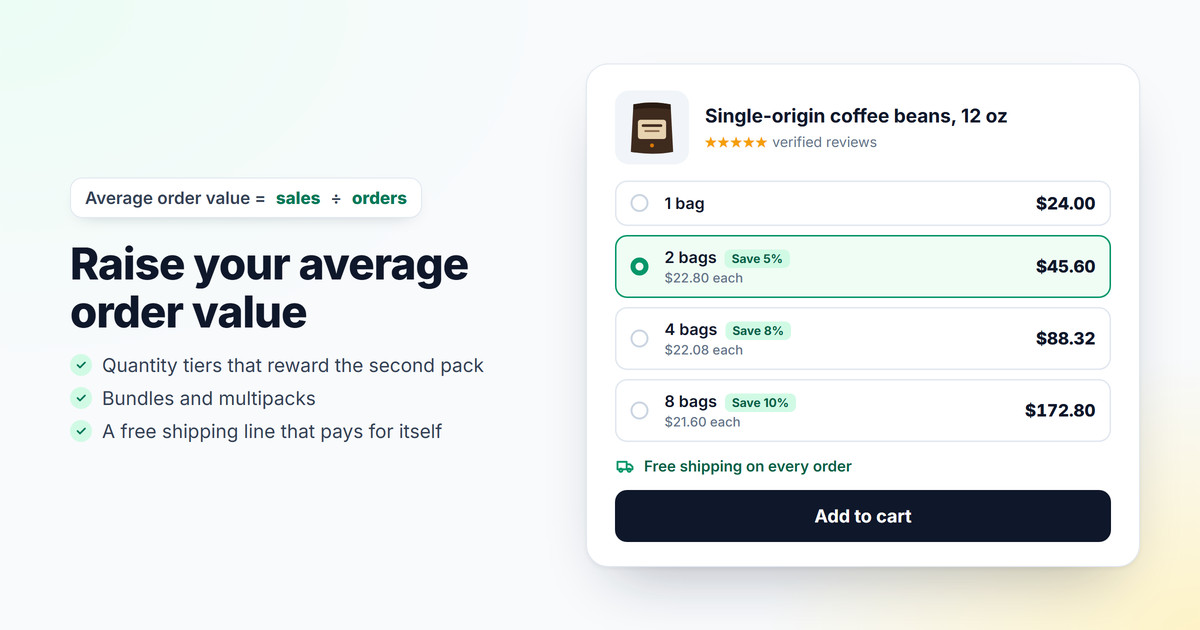
A quantity discount gives a lower price per item when the shopper buys more of the same product. camelway.eu gives 5% off at 2 packs, 8% at 4 and 10% at 8 or more. The steps are small on purpose. The raw material is the main cost of the product, so the margin is thin, and a bigger discount would cost more than the extra packs earn.
The math decides whether a tier pays. Take a $24 product that costs $14, so one unit earns $10:
| Order | Price | Profit | Compared with one unit | Cost if the shopper would have bought that many anyway |
|---|---|---|---|---|
| 1 unit | $24.00 | $10.00 | 1x | $0 |
| 2 units, 5% off | $45.60 | $17.60 | 1.8x | $2.40 |
| 4 units, 8% off | $88.32 | $32.32 | 3.2x | $7.68 |
| 8 units, 10% off | $172.80 | $60.80 | 6.1x | $19.20 |
A tier pays when it turns single-unit buyers into multi-unit buyers, and it costs you the last column of the table when the shopper would have bought that many units anyway. Consumables suit tiers best. Food, supplements and cosmetics get used up and bought again.
On Shopify you can build the tiers without an app. Create one automatic discount per tier: Discounts, then Create discount, then Amount off products, with the method set to Automatic discount, a minimum quantity of 2, 4 or 8 items and 5%, 8% or 10% off. When several apply, Shopify always gives the shopper the best one, and a store can have up to 25 automatic discounts active. Show the tiers on the product page and nudge the cart with a line such as "Add 1 more to get 5% off", as the product page checklist describes. WooCommerce needs a plugin for quantity tiers. CartHacker's Volume Discounts Engine is in development for both: it is included in CartHacker Premium and due in Q1 2027.
Bundles and multipacks
A bundle sells several products as one item at one price, and a multipack sells several units of the same product. On Shopify, the free Shopify Bundles app builds both on every plan, with up to 30 products in a fixed bundle and stock that stays in sync. WooCommerce needs a bundles extension or plugin. Pair products people already buy together, and price the bundle a little below the sum of its parts.
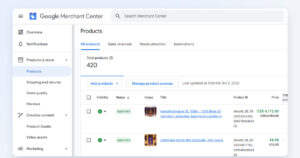
Multipacks have one more advantage for producers. On camelway.eu, which sells 3-packs, each one appears in Google Merchant Center as a product of its own, with its own price and photo, so the store shows up for more searches. Google asks you to mark a pack you put together yourself with the multipack attribute, for example 3, and to price the whole pack. It is worth it for stores that make or pack their own goods, much less for resellers. How to get your products into Google Shopping covers the feed side.
Free shipping thresholds: do the math first
Shipping costs are the top reason shoppers leave a checkout: 40% of the US shoppers in Baymard Institute's survey named extra costs such as shipping. A threshold such as "Free shipping over $75" answers that and pulls small orders up. It can also lose money. Michael Lewis, Vishal Singh and Scott Fay studied an online retailer that had tried many shipping fee schedules, and found that free shipping and free shipping over a threshold were very effective at generating sales, yet the shipping revenue given away made those promotions unprofitable for the retailer.
The rule follows from one equation: an order that tops up to the threshold pays for itself only if the sales it adds, times your margin, cover the shipping you now pay. With $8 shipping and a 40% margin, the top-up has to add more than $20. That is $8 divided by 0.40. Orders that already reached the threshold are the hidden cost, because they earn nothing extra and lose the shipping you used to charge. Here is an example store, with 200 orders a month, a $60 average order, $8 shipping it used to charge and a 40% margin:
| Threshold | Orders already above it | Of the rest, share that top up | Average top-up | Margin gained | Shipping given away | Net per month |
|---|---|---|---|---|---|---|
| $60 | 45% | 30% | $12 | $158 | $984 | -$826 |
| $75 | 20% | 30% | $18 | $346 | $704 | -$358 |
| $90 | 10% | 25% | $30 | $540 | $520 | +$20 |
An invented store, to show the method. The shares are guesses that you replace with your own order data.
Thresholds near the average order lose money, because too many orders already qualify and the top-ups are too small. Set the line above most of your current orders, at a point where the top-up a shopper needs is bigger than your shipping cost divided by your margin, and test it for a full month. Then watch two numbers. One is the share of orders at or above the line; the other is your margin per order.
Or build shipping into the price
There is a second way. It suits stores with one main product. On camelway.eu the price went up by €8, and the store ships free from the first pack to most European countries. The shopper pays part of the DHL cost through the price and the store pays the rest, and the price was set to a level that looks right and that the business can afford. Only where DHL is really expensive does the store keep a threshold: £100 in the United Kingdom and CHF 150 in Switzerland.
The gain goes beyond the page. Free shipping from the first item is a stronger offer in Google Merchant Center and in Google Ads, where the shipping cost appears next to the price, and it removes the surprise at checkout entirely. The trade-off is a higher price on the page, so it works best when the product's value is clear enough to carry it.
Read every new guide 2 weeks early, with no ads
Premium also opens all 50 trust badges in 30 languages, keeps 180 days of your Core Web Vitals, removes the limit on PDF tools and tracks 200 QR codes.
See CartHacker PremiumAverage order value checklist
- Track AOV monthly against your own past, not other categories.
- Count returning customers next to it, because they often move sales more.
- Small quantity tiers, such as 5% at 2, 8% at 4 and 10% at 8, where margins allow.
- Bundles of products bought together, priced a little below the sum of their parts.
- Multipacks as their own products in Merchant Center, if you pack your own goods.
- A free shipping threshold above most orders, where a top-up beats shipping divided by margin.
- Or shipping built into the price, free from the first item.
Average order value questions store owners ask
What does AOV mean?
AOV stands for average order value: the average amount a shopper spends on one order. It is calculated as total sales divided by the number of orders over the same period.
What is the average order value formula?
Average order value = total sales / number of orders. $12,000 of sales in 200 orders is an AOV of $60.
Does free shipping increase average order value?
A free shipping threshold usually does, because shoppers add items to reach it. Research on a real online retailer found such offers very effective at generating sales and still unprofitable once the lost shipping revenue was counted, so set the threshold with the math, not by feel.
What is a good average order value?
It depends on what you sell, and Dynamic Yield's benchmark shows about $71 for beauty, $81 for food and beverage and $421 for luxury and jewelry. The useful comparison is your own AOV against your previous months.
Sources
- Lewis, M., Singh, V. and Fay, S. (2006). An Empirical Study of the Impact of Nonlinear Shipping and Handling Fees on Purchase Incidence and Expenditure Decisions. Marketing Science, 25(1), 51-64.
- Reichheld, F. and Schefter, P. (2000). E-Loyalty: Your Secret Weapon on the Web. Harvard Business Review, July 2000.
- Baymard Institute: Cart abandonment rate statistics. Dynamic Yield: Average order value benchmarks, checked October 5, 2026.
- Shopify Help Center: Discount combinations and Shopify Bundles. Google Merchant Center Help: Multipack.
- camelway.eu, Shopify Analytics, average order value and total sales by new and returning customers, January 2024 to September 2026; monthly figures read from the charts.