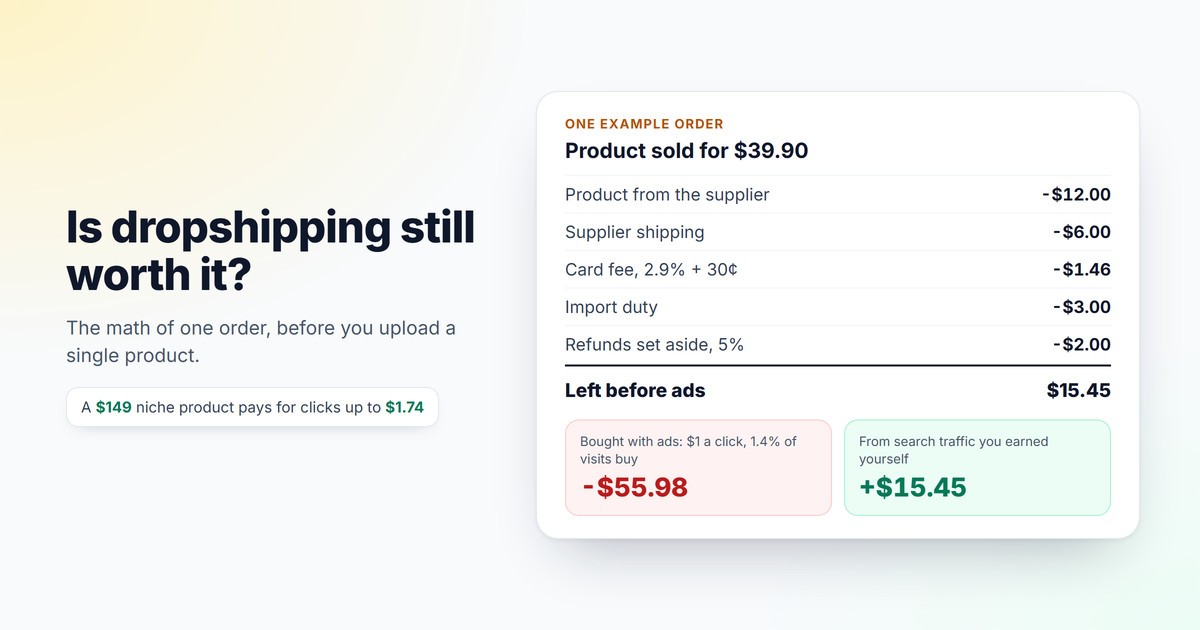
Here's a dropshipping order that looks fine on paper. A shopper pays $39.90 for a product you buy from your supplier for $12, and after shipping, card fees, import duty and a refund reserve, $15.45 is left. Now add the ads that brought the shopper in. At $1 a click and the conversion rate of a median Shopify store, winning that one order costs $71.43, more than four times what the order left you.
If you're planning the classic start, importing 20,000 supplier products and running ads to them, that order is the business model, and it loses money on every sale. Is dropshipping worth it, then? For a different plan, yes: pick a niche, sell 100 to 200 products and spend years building the store's search traffic and reputation. I checked every price and rule in this article on October 5, 2026.
What is dropshipping?
Dropshipping is selling without stock. You list a supplier's products in your store, a shopper orders and pays you, and the supplier packs and ships the order straight to the shopper. You skip the warehouse, but you don't skip the work: product pages, photos, advertising, customer service, returns and the legal guarantee all stay with you, because the shopper bought from you.
On Shopify, supplier apps connect a catalog to your store and send each order to the supplier automatically. Everything else works the way it does for any other Shopify store, the setup, the fees and the work included.
What does one dropshipping order really earn?
Here's the order in full. You sell the product for $39.90 and buy it for $12, plus $6 for the supplier's shipping. Shopify's Basic plan takes $1.46 in card fees (2.9% plus 30 cents), the import duty is $3, and I've set aside 5% for refunds and replacements, another $2. What's left before you've paid for a single visitor is 39% of the price:
| One example order | Amount |
|---|---|
| Price paid by the shopper | $39.90 |
| Product from the supplier | -$12.00 |
| Supplier shipping | -$6.00 |
| Card fee, 2.9% + 30¢ on Shopify Basic | -$1.46 |
| Import duty | -$3.00 |
| Refunds and replacements set aside, 5% | -$2.00 |
| Left before advertising | $15.45 |
It's an invented order to show the method, so swap every line for your own supplier's prices. Shopify's card fees are explained in how much Shopify really costs each month.
What changed for imports in 2025 and 2026?
A couple of years ago that table wouldn't have had a duty line. The cheap direct parcel from a factory on the other side of the world was what the classic dropshipping store was built on, and it now costs more on both sides of the Atlantic:
| Since | Where | What changed |
|---|---|---|
| December 13, 2024 | European Union | The General Product Safety Regulation requires a responsible business established in the EU for every product sold there. |
| August 29, 2025 | United States | Duty-free treatment of imports worth up to $800 ended for every country, so every low-value parcel pays the applicable duties, taxes and fees. |
| July 1, 2026 | European Union | A flat duty of €3 on each kind of item in a parcel worth less than €150, charged on goods from sellers registered in the EU's import VAT scheme, which covers 93% of ecommerce parcels into the EU. |
The $3 in the example stands in for the EU's flat €3 per kind of item. US duties vary by product and country of origin, so look up the rate for your own products before you trust the example.
What do paid ads do to that order?
Ads are paid per visit, so the ad cost of one order is the price of a click divided by the share of visits that buy. At $1 a click and a 1.4% conversion rate (the median for Shopify stores in Littledata's benchmark), you need about 71 paid visits for one sale, and that's where the $71.43 comes from.
Is $1 a click realistic? In the campaigns I've run in Europe, for a very niche product, a click cost between $0.50 and $3, depending on the country, the market and the position you aim for. Here's what that range does to the example order:
| Share of visits that buy | $0.50 a click | $1 a click | $2 a click | $3 a click |
|---|---|---|---|---|
| 1.4%, median store | $35.71 (-$20.27) | $71.43 (-$55.98) | $142.86 (-$127.41) | $214.29 (-$198.84) |
| 2.6%, top 20% of stores | $19.23 (-$3.78) | $38.46 (-$23.01) | $76.92 (-$61.48) | $115.38 (-$99.94) |
| 3.4%, top 10% of stores | $14.71 (+$0.74) | $29.41 (-$13.96) | $58.82 (-$43.38) | $88.24 (-$72.79) |
Ad cost per order for the example order, with the profit or loss after ads in brackets. Conversion rates from Littledata's benchmark of 421 Shopify stores, summer 2026.
Only one cell in that table makes money, the top 10% of stores at 50 cents a click, and it makes 74 cents. The example order breaks even at $0.22 a click for a median store, $0.40 for the top 20% and $0.53 for the top 10%.
Published benchmarks point even higher: WordStream and LocaliQ measured an average of $3.49 a click and a 3.83% conversion rate for the Shopping, Collectibles and Gifts category across their 2025 search campaigns, which is $91 of ads per conversion. Social media ads follow the same arithmetic with their own prices, and what a good conversion rate looks like explains where the conversion figures come from.
Why does the 20,000-product store fail?
Most beginners underestimate the work. In my experience, nine in ten expect to set up a store, upload 20,000 products and start earning. But nobody searches for a store that copied the same supplier descriptions as thousands of others, so the store gets no free traffic and has to buy every visit at the prices in that table.
Google's spam policies say so outright. They list scaled content abuse, meaning many pages generated mainly to rank and not to help people, and a site that breaks those rules can drop in the rankings or vanish from Google's results altogether.
The products themselves carry risk: in a European customs check of 20,000 toys and small electronics, more than half didn't meet EU product standards, and 84% of the ones tested in a laboratory were found dangerous, according to the European Commission in January 2026. Before you list a product, check it against the EU or US safety rules, and for the EU, find out which responsible business stands behind it.
Delivery is the next thing I'd test. In Baymard Institute's survey of shoppers who abandoned a checkout, 20% gave slow delivery as a reason, so don't take a supplier's delivery estimate on trust. Order one product to your own address and time it yourself.
Dropshipping is legal in the EU, but the law treats the store as the seller, so returns, replacements and the legal guarantee are your problem and not the supplier's. Every seller there owes the shopper a 14-day right of withdrawal and two years of legal guarantee, whoever shipped the parcel and wherever it came from. A store that can't keep its guarantees loses its reviews, and with them the trust that makes the next order cheaper.
The dropshipping store that works
What I've seen work is the opposite plan. Instead of 20,000 products, pick one niche and 100 to 200 products you can sell better than anyone: premium LED lighting, for example, or tools for one specific trade. Write your own descriptions and translate them properly, shoot your own product photos and short 360-degree or looping videos, and keep the store's guarantees. The product page checklist covers what those pages need.
Building a store like that takes years, not weeks, and it only works for an owner who's prepared to put in those years. A focused store with 100 to 200 products, each with its own description, photos and video, can rank and convert, and 20,000 copied listings mostly can't.
I'd also look at higher prices, because they change the math. Take a $149 premium product with a similar cost structure: $55 to the supplier, $12 for shipping, card fees, duty and the same refund reserve. It leaves $66.93 before ads, enough to pay up to $1.74 a click at a 2.6% conversion rate, or $0.94 for a median store, and that's inside the range real campaigns cost.
There's a catch: expensive products convert less often. In Dynamic Yield's benchmarks, luxury and jewelry stores convert 0.69% of visits, and at that rate the $149 product breaks even at about $0.46 a click, so test with a small budget before you scale.
Start with traffic you earn
A visit from search costs nothing, so a search order keeps everything that was left before ads. That's why the better start is your own time and not an ad budget: learning search engine optimization (SEO), writing pages that deserve to rank, and earning links from people who find your store worth citing.
Never buy links from link sellers. Google's spam policies name buying links for ranking purposes, and a store that does it can lose the rankings it paid for. How to get your Shopify store found on Google covers the basics, and free product listings in Google Shopping are another source of unpaid visits, explained in how to get your products into Google Shopping.
A new store with no history also has to prove it's real. Ozpolat and Jank (2015) looked at 493 retailers and over 250,000 transactions, and third-party trust seals paid off most for the newer merchants among them and for shoppers with little online experience. What the research says about trust badges goes through the rest of the evidence.
Returning customers cost nothing to win a second time, and that's why the three automated emails every store should send are worth setting up before the first sale comes in.
Show first-time shoppers your guarantees under Add to cart
Pick the promises shoppers look for, from free shipping to a money-back guarantee, and show them on Shopify, WooCommerce or any other store. A free account gets 8 trust badges and their view counts.
Build my trust badgesIf you make your own products
Few stores make what they sell, and for those that do, dropshipping is one more sales channel, because a producer can supply other stores and let them do the selling.
camelway.eu, which I built and ran, does exactly that through supplier apps such as Syncee and AutoDS, which list a producer's catalog so that dropshipping stores can import the products and send their orders straight back to the producer. Listing on Alibaba.com, the business-to-business marketplace, reaches wholesale buyers as well.
An affiliate program costs little to start. UpPromote's free plan covers unlimited affiliates and one program, with up to $3,000 of referral sales a month, and paid plans start at $29.99 a month for stores that outgrow it. Bloggers, reviewers and loyal customers then sell for a commission, which you pay only after a sale. For a producer, I'd use every one of these channels before giving up on any of them.
Your own break-even click price
Before you import a single product, work out one number. Take what's left of an order before ads, with your supplier's real prices, shipping, duty and refunds, and multiply it by the share of visits you expect to buy. That's the most you can pay for a click without losing money on the sale.
For the $39.90 example at a median conversion rate it's 22 cents, less than half the cheapest click in the European campaigns I've run. If your own number comes out below what clicks cost in your market, ads alone can't make the store profitable, and it'll need the niche, its own pages and search traffic first.
Sources
WordStream and LocaliQ, U.S. Customs and Border Protection, Council of the European Union and 3 more6
- WordStream and LocaliQ: Google Ads benchmarks 2025, more than 16,000 campaigns, April 2024 to March 2025. Littledata: Ecommerce conversion rate benchmarks. Dynamic Yield: Conversion rate benchmarks.
- U.S. Customs and Border Protection: E-commerce frequently asked questions; The White House: Suspending duty-free de minimis treatment for all countries.
- Council of the European Union: Customs duty on small parcels as of July 1, 2026. European Commission: Customs control action on third-country ecommerce goods and General Product Safety Regulation (EU) 2023/988.
- Google Search Central: Spam policies. Baymard Institute: Cart abandonment rate statistics. UpPromote: Pricing.
- Ozpolat, K. and Jank, W. (2015). Getting the most out of third party trust seals: An empirical analysis. Decision Support Systems.
- Example order and break-even click prices: CartHacker calculation, October 2026 (research/5003/economics.py).
Discussion 0
Ask a question or share what you saw on your own store.
No comments yet.