Thirty-two Shopify stores in my sample tell their customers to send returns to "[INSERT RETURN ADDRESS]". That's the placeholder from Shopify's old refund policy template, published word for word on live stores that take real orders.
I found them when I collected the return policy of 1,600 Shopify stores, picked at random from Google's list of the million most visited websites. Most policies aren't that careless. But a lot of them are built from the same few sentences, and many skip the first thing a shopper wants to know: who pays to send it back?
If you're writing your store's return policy now, or you haven't looked at the one you copied two years ago, here's what 1,600 real stores promise, a return policy template built from the most common choices, an example for stores that don't take returns, and where to add the policy in Shopify and WooCommerce.
What a typical return policy promises
The middle of the market looks like this: returns for any reason within 30 days of delivery, the money back to the original payment method, the customer pays the return postage, and sale items can't be returned. If you copy that, you promise what most shoppers already expect, and nobody will be surprised later.
The details spread more than I expected. Some stores give 7 days, one gives a full year, and almost a third of the stores that take returns never say who pays the shipping. Which group is your store in?
| What the policy says | Share of stores |
|---|---|
| Has a refund policy at the standard Shopify address | 84.8% of 1,600 stores |
| Takes returns when the customer changed their mind | 76.0% |
| Takes back only damaged, faulty or wrong items | 20.1% |
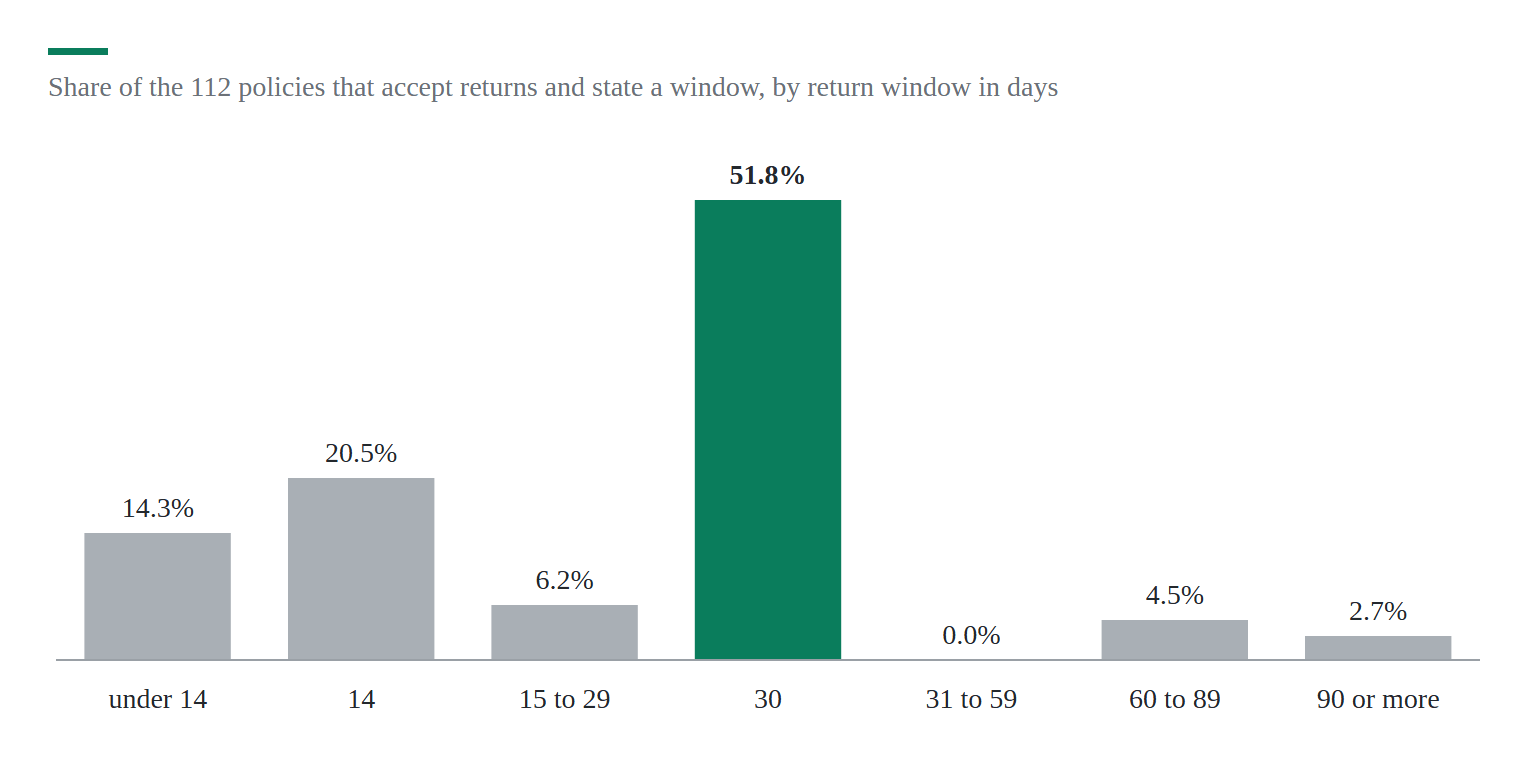
| Return window of exactly 30 days | 51.8% of stated windows |
| Return window of 14 days | 20.5% |
| Return window under 14 days | 14.3% |
| Return window of 60 days or more | 7.1% |
| Customer pays the return shipping | 59.5% of stores that take returns |
| Free returns | 7.2% |
| Doesn't say who pays the return shipping | 28.8% |
| Refunds money, not only store credit | 95.7% |
| Excludes sale or final sale items | 33.1% of 924 English policies |
| Mentions a restocking or handling fee | 15.6% (the typical fee is 15%) |
| Mentions the legal right to cancel in the EU or UK | 16.2% |
| Gives a longer window for holiday purchases | 1.6% |
| Is built on a Shopify template | 13.4% |
| Still says "[INSERT RETURN ADDRESS]" | 32 policies (3.5%) |
Return policies of 1,600 Shopify stores drawn at random from the Chrome UX Report top one million origins, November 9 and 10, 2026. The rows from "Takes returns" to "Refunds money" come from 160 policies drawn at random and read in full, one at a time; the other rows come from all 924 policies written in English.
Stores in the US take returns more often
Of the US stores in the sample, 90.6% take returns for a change of mind. Outside the US it was 67.7%. That gap surprised me at first, because European shoppers have more rights by law, not fewer.
I think the law is the reason. In the US there's no general federal right to return something bought online, so the store's own policy is the shopper's main protection, and US stores compete on it.
In the EU and the UK every online shopper can cancel within 14 days without giving a reason (EU Directive 2011/83/EU, and the UK's Consumer Contracts Regulations), so some stores outside the US write "no returns" and expect the law to cover the rest.
A "no returns" line doesn't remove the 14 days. If you sell to customers in the EU or the UK, they can still cancel, and a policy that says otherwise is simply wrong. Only 16.2% of the English policies mention that right at all. Most of those use the same Shopify sentence ("notwithstanding the above, if the merchandise is being shipped into the European Union..."), which appeared in 56 policies.
Who pays for return shipping? Say it in the policy
Among the stores that take returns, 59.5% make the customer pay the return shipping and only 7.2% offer free returns. The rest (28.8%) don't say. A shopper reading those policies can't tell whether a return will cost them $0 or $12. Does yours say it?
Free returns matter to buyers: in the National Retail Federation's 2025 returns report, 82% of consumers said free returns matter when they shop online. A study of two large online retailers by Bower and Maxham (Journal of Marketing, 2012) found something worse for stores that charge: customers who paid for their own return shipping cut their later spending with that retailer sharply, while customers who got free returns spent more afterwards.
You don't have to offer free returns to fix this. If you can't afford them, write plainly that the customer pays, and pay it yourself when the item arrived damaged or wrong (in many countries that's your duty anyway). A clear answer is better than a gap the shopper has to fill with a guess.
Return policy template you can copy
This template follows the most common choices in the sample and adds the three lines most policies were missing: who pays the shipping, what happens with a faulty item, and the 14 days for EU and UK customers. Replace every part in square brackets, delete the options you don't use, and delete the section for EU and UK customers if you don't ship there.
Returns and refunds

You can return most items within [30] days of delivery for a full refund.
Items must be unused, in their original packaging, with the tags attached.

How to start a return
Email us at [[email protected]] with your order number. We'll reply
within [2] business days with the return address and the next steps.
Please don't send anything back before we confirm the return.

Return shipping
[You pay the cost of return shipping.] [Returns are free: we'll email you
a prepaid return label.] If your item arrived damaged, faulty or wrong,
we pay the return shipping and send a replacement or a full refund,
whichever you prefer.

Refunds
We refund your original payment method within [5] business days after
your return reaches us. Your bank may need a few more days to show it.

Items we can't take back
[Final sale items, gift cards, personalized items and opened beauty
products] can't be returned unless they arrived damaged or faulty.

Exchanges
To change a size or a color, start a return and place a new order. If
you email us first, we'll keep the new item for you.

Customers in the EU and the UK
You can cancel your order within 14 days of delivery without giving a
reason. Tell us by email within those 14 days, then send the items back
within 14 days of your email. We refund the price and the standard
delivery cost within 14 days of your email (we may wait until the items
reach us). [You pay the cost of sending the items back.]

Holiday purchases
Orders placed between [November 1] and [December 24] can be returned
until [January 31].

Questions? Email us at [[email protected]].
Before you publish, search the finished text for a square bracket. That's how 32 stores ended up asking customers to mail returns to "[INSERT RETURN ADDRESS]". The 13.4% of policies built on a Shopify template share whole sentences, too: "You'll also need the receipt or proof of purchase" appeared in 98 policies, almost always in stores that don't issue paper receipts at all. Read every sentence and keep only what your store really does.
A restocking fee is the one choice I'd think twice about. Only 15.6% of the policies mention one (usually 15% of the price), and it's a line a hesitant shopper reads just before they decide not to buy. If you need it for large or custom items, limit it to those items and name them.
No return policy example that still follows the law
One store in five in the sample takes back only damaged, faulty or wrong items. That can be the right choice for food, made-to-order products or cheap items where postage costs more than the product. A good no return policy still says what happens when something goes wrong, because a shopper with a broken item and no answer files a chargeback with their card company instead.
All sales are final

We don't accept returns or exchanges if you change your mind.

If your order arrives damaged, faulty or different from what you ordered,
email us at [[email protected]] within [7] days of delivery with your
order number and a photo. We'll send a replacement or refund you in full,
including the shipping cost.

Customers in the EU and the UK: you can still cancel your order within
14 days of delivery without giving a reason. Tell us by email, and send
the items back within 14 days of your email. [This doesn't apply to
personalized items, perishable goods or sealed hygiene products that were
opened after delivery.]
The last paragraph is the one most "all sales are final" policies leave out. The exceptions in brackets come from the EU directive itself, so keep only the ones that fit what you sell.
Holiday return policy: only 1.6% of stores have one
Big retailers stretch their return windows for gifts every year, and shoppers check. In Google's Keyword Planner, searches for "best buy holiday return policy" grew 3,700% in the three months to October, and the same jump shows for Walmart, Macy's and Sephora.
Small stores almost never copy it: 1.6% of the English policies give holiday purchases more time. That's an easy promise to add, because a gift bought on December 1 with a 30-day window can only be returned until December 31, and the person who received it may open it on Christmas Day. One line ("orders placed between November 1 and December 24 can be returned until January 31") fixes that, and it's already in the template.
How to add a return policy in Shopify
- Open Settings > Policies in your Shopify admin.
- Under Written policies, click the return policy.
- To let Shopify write it from your return rules, turn on Use automated policy, check the text and click Save. To use your own text, turn Use automated policy off, paste the template, fill in the brackets and click Save.
- Add it to your footer: go to Content > Menus, open the footer menu, click Add menu item, search for the policy, click Add and then Save menu.
Shopify links published policies in the checkout footer by itself, and the policy lives at yourstore.com/policies/refund-policy. That's the address I requested on all 1,600 stores.
If you edit the automated policy, remember that its contact email comes from Store email in Settings > General, and that a returns app (Loop and Redo were the most common ones in the sample) may follow different rules than the text.
On WooCommerce, the plugin creates a draft page called Refund and Returns Policy when you install it. Open Pages, edit that draft, replace its text with your own, publish it and add it to your footer menu. Check the page from a phone too: a policy that's only reachable from the checkout is a policy most shoppers never see before they decide.
Show the return window under Add to cart
A good policy helps only when shoppers know it exists, and most never click the footer link. I'd put the short version (for example "30-day returns") right below Add to cart, where a shopper who isn't sure yet looks for a reason.
Full disclosure: we make free trust badges for this, and a money-back and an easy returns badge are both in the free set. Whatever you use, the number on the badge must match the policy. In the EU, don't advertise the legal 14 days as a store benefit: the Unfair Commercial Practices Directive bans presenting a legal right as something special about your store, so show a badge only when you give more than the law asks.
Show your return window right under Add to cart
Pick the promises shoppers look for, from free shipping to a money-back guarantee, and show them on Shopify, WooCommerce or any other store. A free account gets 8 trust badges and their view counts.
Build my trust badgesHow I collected the 1,600 policies
I took the September 2026 list of the million websites Chrome users visit most, found the 44,472 that run on Shopify, shuffled them and kept the first 1,600. For each store I requested the standard Shopify policy address, one request at a time and only where the store's robots.txt allowed it, between November 9 and 10, 2026.
A script read every English policy for fees, final sale rules, holiday windows and template text. The script was unreliable for the return window, the decision to take returns, the refund form and the return shipping, so those four come from 160 policies drawn at random and read in full one at a time. The data is open on Science Data Bank, and the full write-up with the method is on MPRA.
Sources
Return policies of Shopify stores, Bower and Maxham, Janakiraman, Syrdal and Freling and 7 more10
- Return policies of Shopify stores, dataset (Science Data Bank, November 2026)
- How long do online stores give for returns? Working paper (MPRA, November 2026)
- National Retail Federation and Happy Returns: 2025 retail returns report
- Bower and Maxham: Return shipping policies of online retailers (Journal of Marketing, 2012)
- Janakiraman, Syrdal and Freling: return policy leniency, a meta-analysis (Journal of Retailing, 2016)
- EU Directive 2011/83/EU on consumer rights (the 14-day right of withdrawal)
- UK Consumer Contracts Regulations 2013
- EU Unfair Commercial Practices Directive 2005/29/EC (Annex I, point 10)
- Shopify Help Center: adding store policies
- CrUX Top Lists (September 2026)

Discussion 0
Ask a question or share what you saw on your own store.
No comments yet.