On Monday, October 26, Anthropic put its IPO prospectus on the SEC's website. The company behind Claude wants to list on Nasdaq under the ticker ANT, and the Wall Street Journal says the plan is to raise $100 billion or more. SpaceX set the record in June with $75 billion.
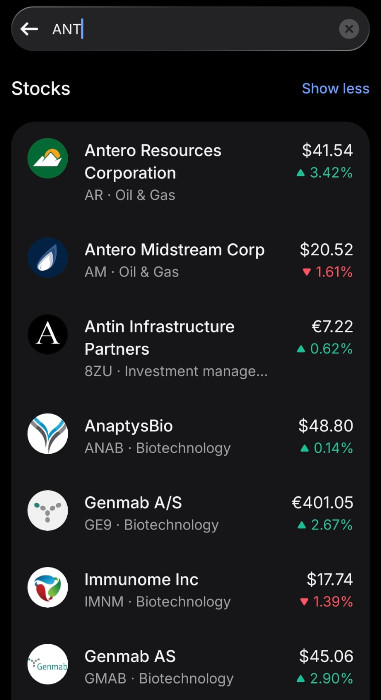
At 6:12 the next morning I typed ANT into my broker app. Antero Resources came up first, then Antero Midstream and a list of biotech companies. Anthropic wasn't there, and it won't be until the shares start trading (the reported target is the week of November 16).
Are you thinking about putting some of your savings into ANT? If you run an online store or a small business, this is for you. I went through the S-1, looked at what happened to SpaceX after its listing and checked the economy both of them list into.
I'm not a financial adviser, so take this as what I found and what I'm doing with my own money: I won't buy on day one, I'm waiting for a crash.
The Anthropic IPO in one table
| Question | Answer on October 27, 2026 |
|---|---|
| Filed | A confidential draft on June 1; the public S-1 on October 26 |
| Exchange and ticker | Nasdaq Global Select Market, ANT (Class A shares) |
| Banks | Goldman Sachs and Morgan Stanley lead 22 banks |
| Expected date | The week of November 16, before Thanksgiving (WSJ report; Anthropic gives no date) |
| Price per share | Blank in the S-1; an amended filing with a price range has to come before the roadshow |
| Reported size | $100 billion or more at $1.5 to $2 trillion (WSJ); Reuters says investors now talk about $1.5 trillion |
| Last private price | $965 billion, in a $65 billion round in May 2026 |
| Who gets shares at the IPO price | Customers of online brokers picked by the banks, plus a retail offer in some EEA countries the S-1 doesn't name |
| Dividends | None paid, none expected |
Should you buy Anthropic stock on day one?
I wouldn't buy Anthropic stock on the first day, and the long record of US IPOs agrees with me. Jay Ritter at the University of Florida keeps that record. Since 1980 the average IPO closed its first day 19% above the offer price, and people who bought at that first close trailed the market by 20.5 percentage points over the next three years. Bought at the offer price, the same IPOs roughly kept up with the market.
So the money on day one goes to whoever got shares at the IPO price, mostly funds and the customers of a few big US brokers. Everybody else pays the opening price, and in a hot listing that price already carries the jump.
Ritter's numbers get worse for expensive listings. The companies that listed at more than 40 times their yearly sales lost 44.8% on average in the three years after their first close, and a $1.5 trillion Anthropic would list at about 76 times the revenue of its last reported twelve months.
That group is small, though, and none of them grew the way Anthropic grows. I read it as a warning about the first-day price, not as a forecast.
SpaceX listed at $135. Seven weeks later it was at $104.83
SpaceX is the closest thing to a test run. Its first four months on Nasdaq look like this:
| SpaceX (SPCX) | Date | Price |
|---|---|---|
| IPO price | June 11, 2026 | $135.00 |
| First trade | June 12 | $150.00 |
| First close | June 12 | $160.95 |
| High | June 16 | $225.64 |
| Low | early August | $104.83 |
| Last close | October 26 | $146.90 |
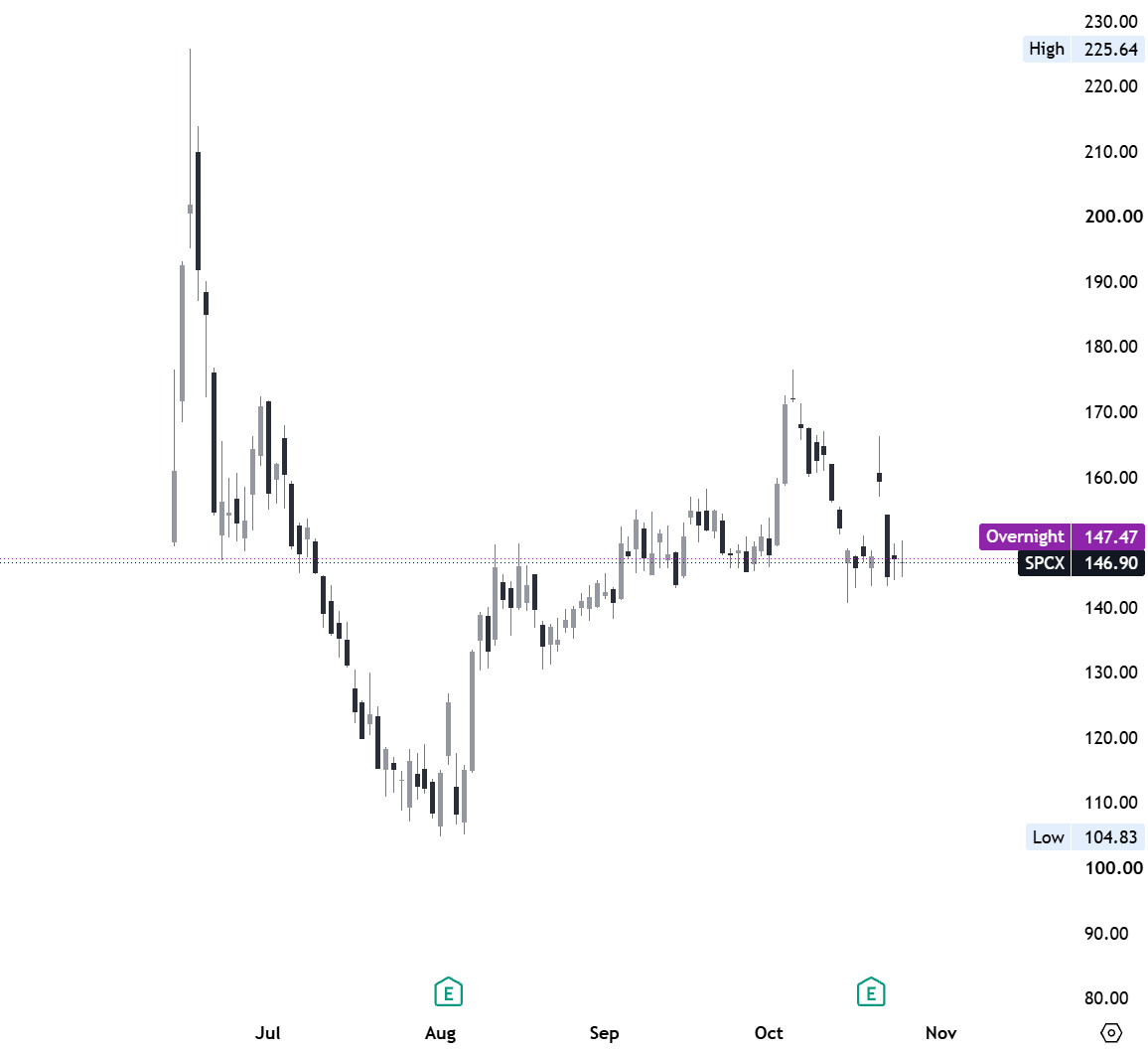
The high came four days after the listing. Seven weeks later the price was 54% below that high, and 22% below what the IPO buyers had paid.
This isn't my story (I didn't buy SpaceX), but it's the one I keep coming back to. Someone who bought at the first close is still down about 9% four months later, and someone who bought near the high is down 35%. And SpaceX isn't a weak company. It's the sixth largest listed company in the US today.
Facebook did the same in 2012: it listed at $38, fell to $17.55 and needed about fourteen months to get back. Figma tripled on its first day last year and trades below its IPO price today. The pattern in these charts repeats: the high comes in the first days or weeks, and the cheaper price comes later.
Anthropic's revenue grew 14 times in a year, and the bill grew too
| Period | Revenue | Source |
|---|---|---|
| 2023 | $41 million | S-1 |
| 2024 | $386 million | S-1 |
| 2025 | $4.6 billion | S-1 |
| First half of 2026 | $16.3 billion (14 times the first half of 2025) | S-1 |
| Third quarter of 2026 | $16.8 billion, up 45% on the second quarter | Reuters, not in the S-1 |
| Net loss, first half of 2026 | $80.7 billion, of which $72.4 billion is a charge on convertible notes | S-1 |
| Operating result, second quarter of 2026 | $974 million profit | S-1 |
The headline you've probably seen is the loss, $80.7 billion in six months. Is Anthropic really burning money that fast? Most of that loss is an accounting charge on convertible notes (the largest holder is Amazon) that grew in value because Anthropic's own price went up. The second quarter on its own made an operating profit.
What worries me more is the bill for computing power. In the second quarter Anthropic spent $5.6 billion on compute against $11.6 billion of revenue, according to Fortune's reading of the filing. It has also signed long contracts for computing power with Google, Amazon, Broadcom, SpaceX's AI unit and others.
About 80% of the revenue is pay as you go, so a customer can spend less next month, while those contracts run for years. The S-1 says it in its own words: growth "may not be sustainable". And growth is slowing. After the third-quarter report, Reuters heard investors talk about $1.5 trillion instead of $2 trillion.
Public shareholders get 49.9% of the vote, at most
This is the part of the S-1 I'd read twice before buying a single share. The Class A shares sold to the public carry one vote each, but all Class A shares together are capped at 49.9% of the vote. One special Class F share, held by a company of the seven co-founders, carries the rest. The Long-Term Benefit Trust holds one more special share that elects four of the seven directors, and Amazon and Google hold shares with no vote at all.
Anthropic is a public benefit corporation, so the board weighs its mission ("the responsible development and maintenance of advanced AI for the long-term benefit of humanity") next to your returns. It has already given 5% of its shares to its own public benefit fund.
The rule I didn't expect: the board may issue up to 2% more shares to that fund each time the price rises 50% above the last milestone, starting from the IPO price. So if ANT does well, your piece of the company gets a little smaller each time.
None of this makes it a bad company. It does mean you buy the money side of Anthropic and almost no say in how it's run.
How big a $1.5 trillion Anthropic would be
| US-listed company | Market value, October 26, 2026 |
|---|---|
| Nvidia | $5.22 trillion |
| Apple | $5.02 trillion |
| Microsoft | $3.95 trillion |
| Alphabet | $3.84 trillion |
| Amazon | $2.69 trillion |
| SpaceX | $2.00 trillion |
| Meta | $1.61 trillion |
| Broadcom | $1.57 trillion |
| Tesla | $1.55 trillion |
| Anthropic, at the reported $1.5 trillion | $1.50 trillion |
| Berkshire Hathaway | $1.17 trillion |
At $1.5 trillion Anthropic would be the 10th largest company on US exchanges on its first day, and at $2 trillion it would pass SpaceX. The money raised would also be the most any IPO has ever raised, about four times Saudi Aramco's listing.
Its closest rival isn't listed. OpenAI's last private price was $852 billion, and Sam Altman has said it won't go public this year. Next to a company that already earns big profits, the price looks steep: Nvidia trades at about 17 times its sales, and a $1.5 trillion Anthropic would trade at about 22 times its third-quarter revenue multiplied by four.
The lock-up calendar: when insiders can start selling
Most IPOs lock insiders in for 180 days and then open the gate all at once. Anthropic's lock-up opens in steps, and the S-1 lists them:
- From the first trading day: some current and former employees and the directors and officers who aren't founders.
- Days 27, 48, 62 and 76 after the prospectus: small slices for the large holders.
- After the full-year 2026 results, then in steps every two weeks.
- Day 180, or the first-quarter 2027 results if earlier: the rest of the regular holders. The founders may sell up to 29% of their shares from then.
- Day 365, or the third-quarter 2027 results: everything else.
Why does this matter to a buyer? Every step puts more shares up for sale. When Facebook's first lock-up ended, its stock fell 6.2% in a day to a record low. Ritter's data also shows the second six months after an IPO is the weakest stretch on average, which is where the 180-day step falls. These are the dates I'll watch.
Oil at $110 and rising rates: the economy ANT lists into
| What I'm watching | Now | For comparison |
|---|---|---|
| Brent crude oil | about $110 to $115 a barrel | $63 in early January; $126 on April 30 |
| US diesel, AAA average | $6.35 a gallon (October 26) | passed the 2022 record of $5.82 on September 11 and kept rising |
| FedEx Ground fuel surcharge | 29.00% (week of October 26) | added to the shipping rate of every Ground and Home Delivery parcel |
| Euro area inflation (HICP) | 3.8% in September | energy up 18.8% in a year |
| US inflation (CPI) | 3.7% in September | gasoline up 34.2% in a year |
| Federal Reserve rate | 3.75 to 4.00% | raised on September 16, the first hike since 2023; futures give a December hike odds of 75 to 85% |
| 10-year US Treasury yield | about 5.0% | 5.35% on October 7, the highest since 2002 |
| Shiller CAPE of the S&P 500 | about 40 | higher only in 1999 and 2000 |
The war with Iran and the repeated closures of the Strait of Hormuz did most of this. Oil went up, diesel went up with it, and every parcel carries a bigger fuel surcharge.
I see it at every gas station, and courier prices went up with fuel, which comes straight out of an online store's margin. If you sell online, the same diesel sits in your shipping costs this holiday season, and I planned for it in my Black Friday 2026 guide.
Prices follow fuel, and the Federal Reserve is raising rates again instead of cutting them. Meanwhile stocks are expensive: the Shiller CAPE (the price of the index against ten years of profits) sits near the dot-com peak. The IMF and the Bank of England both named an AI-led correction as a top risk this autumn, and in Bank of America's October survey of fund managers an AI bubble was the second biggest worry, after bond yields.
None of that tells you when a crash comes. In the oil shock of 1973 and 1974 the S&P 500 fell 48%, while the drop around the Gulf War in 1990 was over in about four months.
Waiting for a crash costs something too
I want to be fair to the other side, because the numbers against waiting are strong. Hartford Funds found that $10,000 left in the S&P 500 from 1996 to 2025 grew to $192,167, while the same money missing only the 10 best days grew to $85,490. J.P. Morgan found that seven of the ten best days came within two weeks of the ten worst. And Vanguard found that putting a sum into global stocks all at once beat spreading it out about two times in three.
What if the crash never comes, or comes after ANT has doubled? That's the real risk of my plan. But all of those studies are about a whole index, which has gone up over long periods. One new stock has no such history, and most single stocks do worse than the market. That's why waiting makes more sense for ANT than it does for an index fund.
If you'd rather not wait for a crash, here's how I'd keep the risk small:
- Use a limit order with your price in it. A hot IPO can open hours after the bell, at a price nobody saw in the morning.
- Buy in parts, around the lock-up steps and the first quarterly report.
- Only put in money you won't need for years.
Buying ANT from outside the US
The S-1 includes a retail offer "in certain member states of the European Economic Area", under a separate EU prospectus. It doesn't say which countries, and the country list will matter for every European reader.
SpaceX's European retail offer in June ran in Germany, France, the Netherlands, Denmark, Norway, Spain, Sweden and the UK, through brokers such as Revolut and eToro. If your country isn't on Anthropic's list, the realistic way in is the market on or after the first trading day.
Be careful with anything sold as "pre-IPO Anthropic shares" before then. In May Anthropic said any sale of its stock without board approval is void, and that people selling tokens or similar products are "likely either engaged in fraud or offering an investment that may have no value". It named offers on Hiive and Forge among the ones it hadn't approved.
You can own a piece of it today through its two big partners. Amazon carried its Anthropic stake at about $190 billion at the end of June, roughly 7% of Amazon's own market value. Alphabet owns about 14% of Anthropic. Both report third-quarter results this week, and their Anthropic gains will be part of those numbers.
One more thing if you earn in euros or pounds. The exchange rate adds its own gain or loss: say ANT rises 10% while the dollar falls 10% against your currency, and you end up about where you started (an example, not a forecast). The tax on the gain depends on the country you live in.
Updates to this article
- October 27, 2026: first version, written the day after Anthropic made its S-1 public. Still to come: the price range in an amended filing (reported for around November 9 or 10), the roadshow, the IPO price and the first trading day.
Sources
Anthropic, PBC, Investing.com, Reuters, via Investing.com and 12 more15
- Anthropic, PBC: Form S-1 registration statement, filed with the SEC on October 26, 2026 (offering terms, financial data, share classes, lock-up schedule, offerings outside the US), and the June 1, 2026 announcement of the confidential draft.
- Investing.com, citing the Wall Street Journal: Anthropic files for Nasdaq IPO as revenue jumps to $16.3 billion (target week, raise and valuation range, compute obligations).
- Reuters, via Investing.com: Factbox: Anthropic moves closer to blockbuster listing with US IPO filing, and via Yahoo Finance: investors push Anthropic to cut its IPO valuation (third-quarter revenue).
- Fortune: Anthropic's S-1, October 26, 2026 (second-quarter compute spending).
- NBC News: Anthropic secures $965 billion valuation (and OpenAI's $852 billion). The Motley Fool: why Anthropic is racing to IPO while OpenAI waits.
- Jay R. Ritter, University of Florida: Initial Public Offerings: Updated Statistics, October 2026 (first-day returns, three-year returns, price-to-sales groups, returns by six-month period).
- CNBC: SpaceX raises $75 billion in record-setting IPO and SpaceX IPO live updates, June 2026. SPCX price chart: TradingView.
- Associated Press, via Phys.org: Facebook stock closes above its IPO price, August 2013; TechCrunch: Facebook stock dips below $20, August 16, 2012. CNBC: Figma after its IPO pop; StockAnalysis: 2025 IPOs and their returns.
- CompaniesMarketCap: largest US companies by market cap, October 26, 2026 close. Dealroom: the biggest IPOs of all time.
- Wikipedia: 2026 to 2028 world oil market chronology; Trading Economics: Brent crude oil; MacroMicro: AAA national average diesel price; FedEx: weekly fuel surcharge.
- Eurostat: euro area annual inflation, September 2026 flash estimate.
- US Bureau of Labor Statistics: Consumer Price Index, September 2026. CNBC: Fed rate decision, September 2026 and expectations for the October meeting. Forbes: why the 10-year Treasury yield just hit a 24-year high.
- GuruFocus: S&P 500 Shiller CAPE ratio. IMF: global financial markets face rising risks from AI, bond yields and cyberattacks. Yahoo Finance: Bank of England warns on AI valuations. Bloomberg: BofA poll of fund managers, October 13, 2026.
- Hartford Funds: timing the market is impossible. J.P. Morgan Guide to Retirement 2024, via 401k Specialist: the folly of timing the market. SmartAsset on Vanguard's study: lump sum investing research.
- Euronews: SpaceX IPO: how European retail investors can buy shares. CoinDesk: Anthropic fights unauthorized stock exposure, May 12, 2026. The Motley Fool: Amazon's stake in Anthropic and Alphabet's Anthropic stake.

Discussion 0
Ask a question or share what you saw on your own store.
No comments yet.